Local SEO Services in London for Businesses That Need the Phone to Ring
I'm Rehman, a London local SEO specialist. I get trades and service businesses into the Google map pack — and into the answers ChatGPT, Perplexity and AI Overviews give — with published pricing, rolling monthly terms, and one person doing the work you can actually reach.
★★★★★4.9 average client rating100+ local businesses ranked
Free Local SEO AuditNo retainer · 24-hour turnaround
Get a free local SEO audit of your Google Business Profile
Fill in your details below to receive a personalized analysis of your Google Business Profile and local rankings.
213%
avg. lift in calls & direction requests
100+
local businesses ranked
#1
map pack for core keywords
£185
entry pricing, published
Google Business Profile◆
Map Pack Rankings◆
✓ Google Partner◆
Citations & NAP◆
Review Growth◆
✓ No Lock-in Contract◆
Local Link Building◆
Landing Pages◆
✓ Companies House Reg.◆
Local SEO Audits◆
AI Search Visibility◆
Reputation Management◆
Google Business Profile◆
Map Pack Rankings◆
✓ Google Partner◆
Citations & NAP◆
Review Growth◆
✓ No Lock-in Contract◆
Local Link Building◆
Landing Pages◆
✓ Companies House Reg.◆
Local SEO Audits◆
AI Search Visibility◆
Reputation Management◆
Certified & verified
Google PartnerGoogle Ads CertifiedShopping Ads CertifiedAhrefsShopify Partners
The diagnosis
Why London businesses lose jobs to competitors who rank above them
Not one of these is a content problem, and none of them are fixed by publishing more blog posts. They are configuration and authority problems, and they are usually fixable in a known order.
01of 04
01
You rank outside the radius your customers actually search from
Local results are filtered by where the searcher is standing, not where your office is. A profile configured for a single pin drops out of the pack two or three miles away, which is exactly the distance most callers are at. Service area settings, borough-level landing pages and consistent address data widen the radius you can realistically compete in — but only if all three agree with each other.
02
Your Google Business Profile is set up as the wrong business type
Primary category carries more weight than almost anything else on the profile. A locksmith filed under "Key duplication service" loses to one filed under "Locksmith" regardless of website quality. The same applies to storefront versus service-area configuration: pick the wrong one and you either publish an address you do not want public, or hide the one Google needs to place you.
03
Competitors hold citations and links your listing does not
Prominence is the slowest signal to build and the one most agencies quietly skip, because it takes months rather than weeks. If a competitor is listed consistently across fifty UK directories and you are listed inconsistently across twelve, Google has more corroboration for their details than yours — and it ranks accordingly, even when your business is older and better reviewed.
04
You are paying Google Ads to cover a ranking problem
Ads are a reasonable bridge while organic and map visibility are being built. They become expensive when they are permanent. If you switched the ads off tomorrow and the phone stopped, you are renting your enquiries rather than owning them — and the cost per call rises every year as more competitors bid on the same terms.
The mechanism
What local SEO does for a London business
The map pack versus the organic results
A local search returns two different things. The map pack is the three business listings with a map above them, drawn from Google Business Profile data and ranked mainly on profile signals. The organic results below are ranked on your website. They are separate systems with separate inputs, which is why a business can sit at position two in the map and nowhere on page one organically, or the reverse. On a phone, the map pack occupies most of the first screen, and the majority of local clicks land there. That is the reason profile work usually comes before website work for a service business — but the organic listing is what captures the longer, more considered searches, so neither is optional.
Local SEO versus national SEO for service area businesses
National SEO optimises a site to rank regardless of where the searcher is. The levers are domain authority, content depth and technical crawlability at scale, which is why most published SEO advice is written for e-commerce and enterprise sites. Local SEO optimises for searches where the answer changes depending on where you are standing. The levers are profile configuration, citation consistency, review velocity and borough-level content. A business with a technically excellent website and a thin, unmanaged profile will lose map pack visibility to a competitor with a mediocre website and an actively managed one. The disciplines share fundamentals — site speed, schema, mobile usability — but the things that actually move rankings are different enough to need treating as separate specialisms.
How Google decides which local business to show
Three signals decide the three slots. They are weighted differently, they move at different speeds, and only two of them are meaningfully under your control.
01
Relevance: does your profile match the search?
Your primary category carries more weight than almost any other signal on the profile. Secondary categories, services, attributes and the business description then decide which adjacent searches you are eligible for at all.
02
Distance: how close are you to the searcher?
The least controllable of the three, and worth roughly 15% of the weighting now rather than the 25–30% it carried a few years ago. You cannot move your premises, but you can widen the area you are eligible in.
03
Prominence: how well known are you?
Review count and rating, citation consistency across UK directories, and links pointing at your site. This is the factor you control most and the one that decides most competitive London categories.
Prominence is where most of the time goes. See how we approach local map pack rankings across Greater London.
What we do
Six levers. Every one of them moves local revenue.
We don't sell packages you can't measure. Each service ships with a scorecard tied to calls, booked jobs and borough-level coverage.
01
Google Business Profile Optimization
The front door to your local business. Primary and secondary categories audited, hidden attributes fixed, services and products populated, and a posting cadence that keeps the profile active rather than dormant.
Map pack positioning is governed by relevance, distance and prominence. All three are worked together, because lifting one while the others lag produces movement that does not hold.
Conflicting phone numbers or an old address across UK directories quietly erode Google's confidence in your details. Name, address and phone data cleaned and synchronised across 50+ authoritative UK platforms.
Reviews decide both ranking and conversion. A compliant review-generation system, plus ongoing responses within 48 hours, so the profile reads as actively run rather than abandoned.
Generic guest posts do not move local search. Links are earned from local UK directories, regional press, trade associations and suppliers — sources with genuine geographic relevance to your area.
A slow or badly structured site wastes the traffic the other five services earn. Fast, mobile-first builds with the local schema and conversion paths a service business actually needs.
These get sold as standalone line items elsewhere. Here they are part of the service they belong to, scoped by what your audit actually finds.
Local keyword research for London and its boroughs
Search demand does not distribute evenly across London. The terms that carry volume in Croydon are not the terms that carry volume in Camden, and the modifiers people add — borough, postcode, station, "near me", "emergency" — change by area and by trade. Research is done per borough and per category, then mapped to specific pages rather than pooled into one list.
Location pages and geo silo site architecture
Most competitors publish a bare list of borough links with no structure behind it. A geo silo instead gives each area its own page, links it to the services relevant in that area, and links those back — so authority flows in a deliberate shape rather than pooling on the homepage. This is what makes a borough page rank for its own terms instead of competing with every other borough page you own.
Local schema markup and structured data
LocalBusiness, Service, FAQPage and BreadcrumbList markup, implemented as JSON-LD and validated. Structured data is how a machine reads what you do, where you do it and what you charge, which matters for rich results today and for AI answers increasingly.
Google Business Profile suspension recovery
A suspended listing is invisible in Maps, so nothing else in the system can compound until it is back. Recovery means identifying the specific guideline that triggered it, correcting it at source, then submitting a documented reinstatement request — not resubmitting the same profile and hoping. Where a profile is already suspended at audit stage, this is prioritised ahead of everything else.
Technical local SEO audit
Crawlability, indexation, page speed and Core Web Vitals, mobile rendering, internal linking and duplicate content, checked against what actually blocks a local site rather than a generic 200-point checklist. The output is an ordered list of what is costing you rankings, not a PDF of everything a crawler can flag.
Programmatic SEO for multi-area service businesses
A business covering thirty areas needs thirty pages that are genuinely different, not one template with the place name swapped. Done properly this means real local data per page — competitors, landmarks, demand patterns, response times. Done badly it produces doorway pages that get the whole set filtered. The safeguards matter more than the scale.
AI search · GEO
Getting found in AI search, not just Google
Londoners increasingly ask ChatGPT, Perplexity and Google's AI Overviews for the best option near them. These systems do not rank the way Google ranks, and optimising for them is a different job — one almost nobody in this market is doing properly yet.
1
Top
2
3
ChatGPT
Claude
Gemini
Perplexity
AI Overviews
Copilot
01
How ChatGPT and Perplexity pick which local business to name
These tools do not hold a ranking index the way Google does. When someone asks for the best locksmith in Croydon, the model runs a web search, reads the pages it gets back, and synthesises an answer from whatever those pages state plainly. That means the businesses named are usually the ones that appear in directory listings, local press, review platforms and comparison pages — the sources a search returns — rather than the ones with the strongest domain. Being mentioned consistently across those third-party sources, with identical business details, is what makes a model confident enough to name you.
02
Google AI Overviews and the local pack
AI Overviews sit above the organic results and, for local queries, frequently pull from the same profile and review data that feeds the map pack. The practical effect is that profile quality now influences two surfaces rather than one. Where an Overview appears, it absorbs clicks that used to go to the top organic result, so a business ranking fourth organically but cited inside the Overview can end up with more visibility than the site above it.
03
Making your pages quotable at passage level
A model extracts passages, not pages. A paragraph that states one fact completely — what the service is, where it covers, what it costs, how long it takes — can be lifted and cited on its own. A paragraph that depends on the three paragraphs before it cannot. Writing so that individual passages stand alone is the single highest-leverage change most local sites can make for AI visibility, and it improves the page for human skim-readers at the same time.
04
Entity consistency across your site, listings and citations
A model deciding whether two mentions refer to the same business is doing entity resolution. Every inconsistency — a different trading name on Yell, an old number on a directory, a suite number that appears on some listings and not others — lowers confidence that the mentions are the same company, and a low-confidence entity does not get named in an answer. This is the same NAP discipline that drives map pack prominence, which is why the two outcomes are worked together rather than as separate projects.
05
llms.txt and AI crawler access
Two separate things get confused here. AI crawler access is real and worth checking: if your robots.txt or firewall blocks GPTBot, PerplexityBot or Google-Extended, you have opted out of those surfaces without meaning to. llms.txt is a proposed convention for describing your site to models, and it is worth publishing because it costs nothing — but it is not read by Google Search and no major model treats it as authoritative. Anyone selling it as the route into AI search is selling the cheap part of the job.
Who we work with
Trades we work with across London
Emergency trades behave differently to considered purchases. The searches happen at night, on a phone, with location on, and the caller rings one of the first results rather than comparing five. That changes what is worth working on and in what order.
Most of the work here is with locksmiths, and it is the category the rest of the approach was built around. Everything below is specific to how locksmith search actually behaves rather than generic local SEO with the trade name swapped in.
01
Why locksmith search behaves differently to most local categories
A locksmith search is almost never considered. Someone is locked out, standing on a doorstep or at a car door, searching on a phone with location on, and they will ring one of the first two or three numbers they see. There is no comparison stage, no reading of the website, no second visit. That collapses the entire job down to two things: being inside the pack at that exact location, and having a profile that reads as trustworthy in the two seconds before someone taps call. Blog content, long service pages and link campaigns matter far less here than category accuracy, review recency and a phone number that connects first time.
02
Service area business setup for mobile locksmiths
Most locksmiths are mobile and have no shopfront customers visit, which makes them a service area business in Google's terms. Configured correctly, the address is hidden and a service area is defined instead. Configured incorrectly — a home address published, or a virtual office listed as premises — you get either an address you did not want public or a suspension. This is one of the most common reasons a locksmith profile is suspended, and it is also one of the most recoverable, provided the underlying setup is corrected rather than the same profile resubmitted.
03
Ranking for emergency and auto locksmith terms
"Emergency locksmith" and "auto locksmith" behave as separate categories with separate competitors, even though most locksmiths do both. Auto work in particular pulls a different result set, often including national dispatch networks rather than local firms. Competing means naming the specific work — key programming, spare key cutting, non-destructive entry — in the profile services and on the site, because those are the terms that separate a genuine auto locksmith from a general one in both Google's eyes and the caller's.
The full breakdown lives on the local SEO for locksmiths page, including category configuration and the suspension causes specific to mobile locksmiths.
How it works
A plan you can hold us to, month by month.
Month 1
Audit, baseline and keyword mapping
Profile, citations, site and top three competitors audited, and a baseline captured so later movement is measurable rather than asserted. Keywords mapped to specific pages, and the gaps ordered by what is costing you most.
Months 2–3
Profile, citations and technical foundation
Categories and attributes corrected, NAP cleaned across UK directories, schema implemented, and whatever is blocking indexation fixed. This is the least visible phase and the one everything later compounds on.
Months 4–6
Location pages, content and links
Borough pages built into a geo silo, service content published against the mapped terms, and local links earned from sources with real geographic relevance. Map pack movement is usually clear by this point.
Months 7–12
Authority, reviews and compound growth
Review generation running continuously, link acquisition sustained, and coverage widened into adjacent boroughs and higher-value terms as the core positions hold.
Month 13 onward
Holding position and defending it
Rankings are not owned, they are held. Competitors respond, Google updates, categories shift. Ongoing work is monitoring, reacting and defending the positions already won.
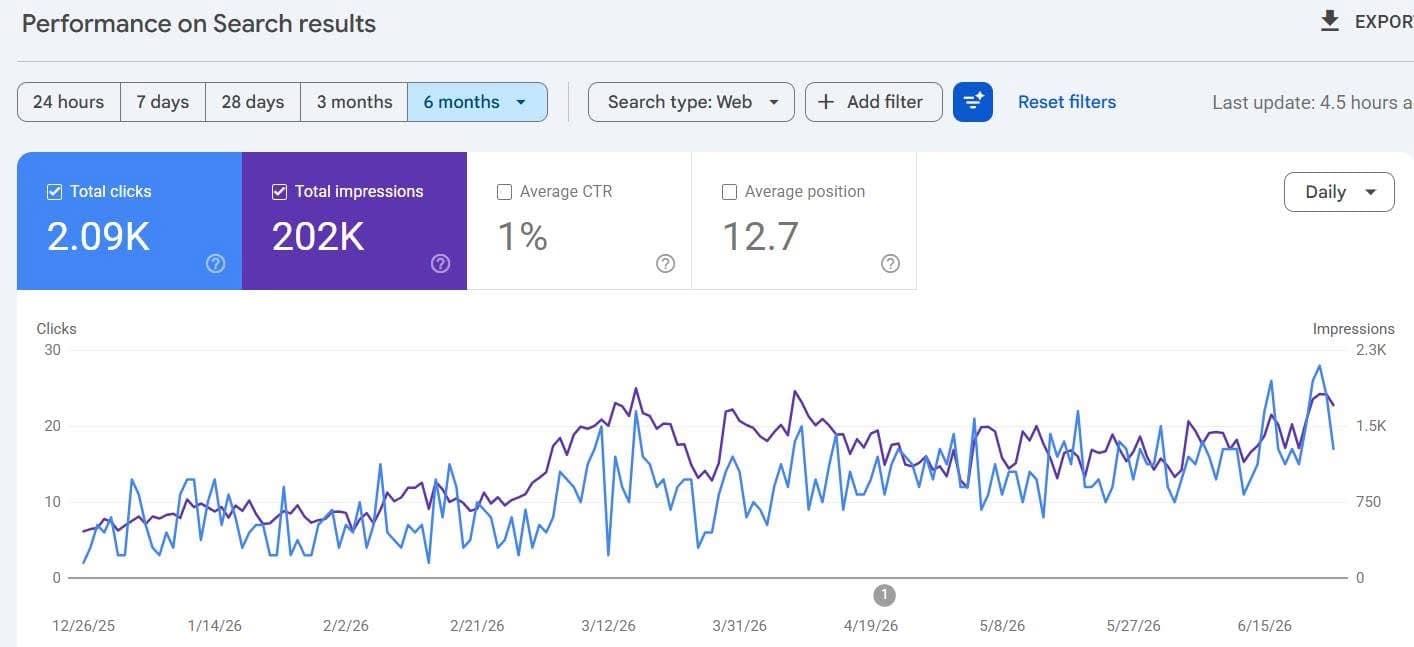
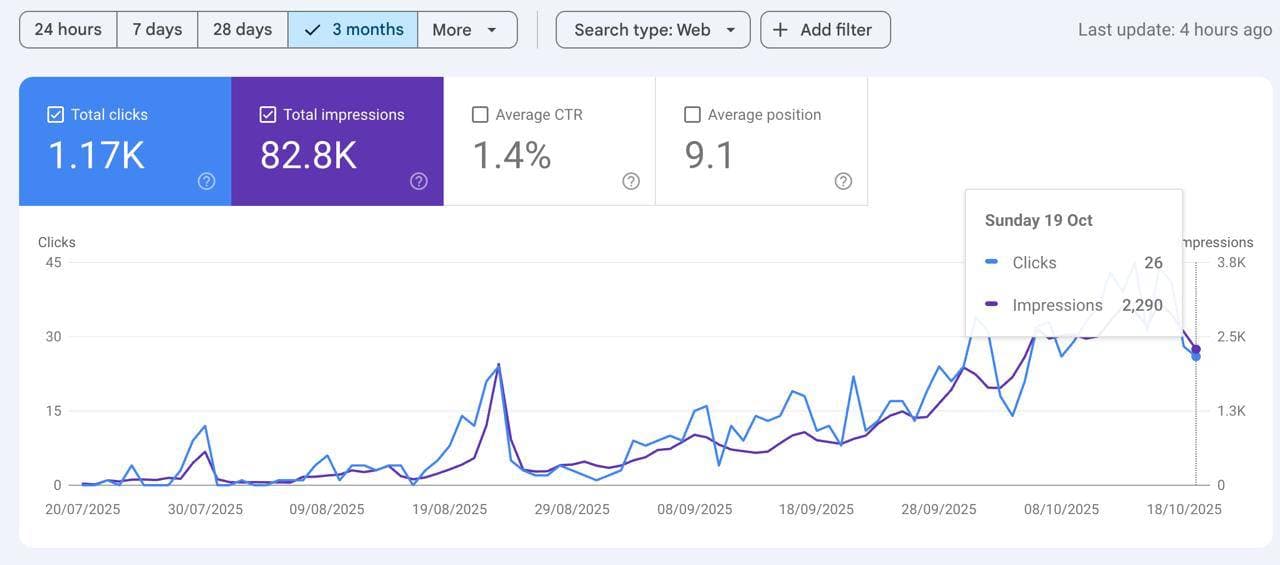
Unedited exports from live client accounts, not redrawn charts.
Performance · Clicks & Impressions01 / 12
Search Console performance snapshot — real campaign data.
Client feedback
Owners talk. That's how local works — and how we grow.
4.9
★★★★★
7 client reviews
★★★★★
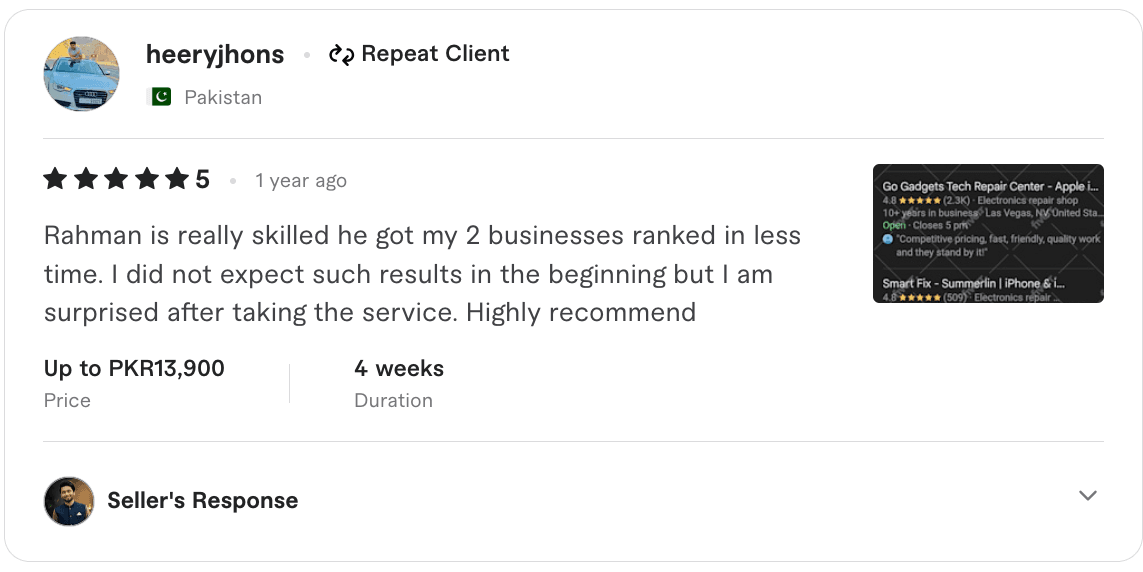
“Rahman is really skilled — he got my 2 businesses ranked in less time. I did not expect such results in the beginning, but I am surprised after taking the service. Highly recommend.”
heeryjhons🇵🇰 Pakistan · 1 year ago
★★★★★
“Working with Rehman was great! He was so friendly and helpful, always taking the time to answer all my questions. Plus, he got the project done really quickly!”
modernbizz🇺🇸 United States · 2 years ago
★★★★★
“Very good at what he does.”
london8484🇺🇸 United States · 2 years ago
★★★★★
“He assisted me well in completing the job.”
vincenttan0660🇲🇾 Malaysia · 2 years ago
Proof
See the original screenshots.
No edits, no cropping out the bad bits — every review above, exactly as it was posted.
Fiverr · Verified Review01 / 7
heeryjhons · Pakistan · 1 year ago — original, unedited screenshot.
London agencies charge 20 to 40 percent more than regional equivalents, and most local SEO retainers in the UK sit between £500 and £2,500 a month. Agencies that will not publish a number usually start near the top of that range. Ours start at £185, and six of the eight agencies currently ranking for this search publish no figure at all.
Basic
For sites already ranking and getting leads, ready to push further
What is not included: paid ad management, social media, branding or web hosting. Where a new site is needed rather than fixes to an existing one, that is quoted separately as a build rather than folded into the monthly fee.
Reporting
What you get in your monthly report
Four things, in this order, in plain language. Nothing in it requires a call to interpret, and every figure in it is one you can verify yourself in your own Google account.
Monthly report · contents
01
Geo-grid rank tracking, not a single-point average
A single average position hides the thing that matters most locally: where you rank changes street by street. A geo-grid checks your position from a spread of points across your service area and shows the result as a map, so you can see the streets you own, the streets you are losing, and whether the radius is widening month on month.
02
Calls, direction requests and profile actions
Pulled directly from the Google Business Profile: how many people rang, how many asked for directions, how many clicked through to the site, and how those numbers moved. These are the actions closest to actual revenue, which is why they lead the report rather than sitting behind traffic charts.
03
Keyword movement by borough
Tracked terms broken out by the area they were searched from, so "emergency locksmith" in Croydon and the same term in Camden are reported separately. A national average across both tells you nothing actionable; the split tells you which area to work next.
04
What changed on your site last month
A plain list of the work done: pages published, citations corrected, links earned, profile changes made, technical fixes applied. You should never have to ask what you paid for in a given month, and you should be able to check any line of it yourself.
Why Rank Me Local
Why work with a specialist instead of an agency
You deal with the person doing the work
Every audit, fix and report comes from Rehman directly. No account manager relaying questions to a team you never speak to, and no handoff between the person who sold the work and the person delivering it.
Local SEO only, no bolt-on services
No paid social, no branding retainer, no CRM implementation. A narrower service means the whole of it stays current, and it means nothing gets recommended because it happens to be profitable to sell.
Trade business focus
Emergency and same-day trades behave differently to considered purchases — different intent, different devices, different times of day. Most of the work here is with trades, which is why the advice is specific rather than generic.
Rolling monthly terms
No minimum term and no lock-in. Cancel with a month's notice and keep everything built — profile, citations, links, content. They were built on your assets rather than rented from ours.
Pricing published on this page
Banded pricing is on the site, starting at £185 a month. You know the range before booking a call rather than after two discovery meetings.
Mechanism over marketing speak
Every recommendation comes with the reason behind it — why a category unlocks new search terms, why citation consistency builds confidence, why a passage-level rewrite affects AI citations. If it cannot be explained, it does not get done.
DIY vs Done-For-You
How we actually compare.
DIY
Cheap Freelancer
Big Agency
Rank Me Local
Time Investment
10+ hours/week with slow progress
Low, but unmanaged tactics
Low, but slow 12-month turnaround
Minimal — clear monthly reporting
Google Compliance Risk
High — easy to trigger suspensions
Unverified methods, hard to audit
Safe, but rigid national templates
Guideline-compliant by design
Pricing Transparency
Free, but requires full learning curve
Cheap initially, extra charges later
Vague retainers hidden in contracts
Banded pricing published from £185
London Market Knowledge
Limited to general online advice
Rarely focused on London trade niches
Generic national playbook, not borough-aware
Postcode & borough-level expertise
Contract Flexibility
N/A
Informal, no guaranteed recourse
Locked into 6 to 12-month retainers
Month-to-month, cancel anytime
Not for everyone
When local SEO is the wrong choice for you
Four situations where taking your money would be the wrong call. If any of these describe you, the audit will say so and you will not get a proposal.
01
You need enquiries inside 30 days
Foundational fixes can move things in two to four weeks, but a competitive London category usually takes three to six months to hold a map pack position. If the business needs calls this month to survive, spend the money on Google Ads and come back to organic once there is runway.
02
Your service has almost no search volume in London
Some services genuinely are not searched for. If nobody is typing your category into Google, no amount of optimisation creates demand that does not exist. The audit will tell you this before you spend anything, and if that is the finding, you will be told plainly.
03
You want a guaranteed number one position
Nobody can guarantee a ranking, because nobody controls the algorithm or what competitors do next. Any agency offering a guarantee is either relying on terms nobody searches for, or planning to blame something else when it does not happen.
04
You are not able to answer the phone when it rings
Local SEO produces calls, most of them from people who will ring the next result if you do not pick up. If calls are already going to voicemail, fixing that will do more for revenue this quarter than anything on this page.
The person
Who you will be working with
2020 → today
from one client to 100+
About Rehman
Rank Me Local started with a single London business and one goal — get them the calls they were missing from Google. No retainer padded with busywork, no jargon-heavy reports nobody reads. That has not changed: every audit, every fix and every monthly report still comes from me personally.
There is no junior team, no offshore reseller and no account manager relaying messages from someone you will never speak to. It is a deliberate constraint rather than a growth stage — it caps how many clients I can take, and it is the reason the advice stays specific.
Ranking in Camden is a different problem to ranking in Croydon. Central boroughs pack more competitors into a tighter radius, so proximity does more of the work and prominence has to carry the rest. Outer boroughs have thinner competition but wider service areas, which changes how the profile should be configured.
Work also covers the wider Greater London area and out to the M25, including boroughs without a dedicated page yet. Service area businesses are frequently configured to cover several boroughs at once, so the borough pages above are a starting point for the areas with the most search demand rather than a limit on where the work applies. The same approach now extends to Business Bay, Dubai — the fundamentals (Google Business Profile accuracy, prominence, citations) travel; the local detail — trade licences, Makani numbers, RERA registration — is built specifically for the UAE market.
FAQ
Local SEO London, frequently asked questions
Local SEO in London typically runs between £500 and £2,500 a month, and Rank Me Local's banded pricing starts at £185. London agencies charge roughly 20 to 40 percent more than regional equivalents for comparable scope, and agencies that will not publish a figure usually start near the top of that range. What you should expect is a number tied to a stated scope of work — which services, in what order — rather than an unexplained flat retainer.
Most London businesses see measurable movement within 60 to 90 days, with foundational fixes showing faster. Correcting a wrong primary category or cleaning inconsistent NAP data can move rankings inside two to four weeks, because it resolves a signal that was actively working against you. Authority-driven gains from reviews and local links build across months three to six. Competitive inner-London categories take longer, because the listings you are displacing are already well optimised.
No. Businesses that travel to customers — locksmiths, electricians, plumbers, mobile services — rank as service area businesses with the address hidden and a service area defined instead. What you do need is a real address to verify with, even if it is never published. What you cannot use is a virtual office or a mailbox as your premises: that is one of the most common causes of Google Business Profile suspension.
The map pack is the three business listings shown with a map above the organic results, and it captures the majority of clicks on local searches. Getting into it is decided by three things: relevance, meaning how well your profile matches the search; distance from the searcher; and prominence, meaning reviews, citations and links. Distance is largely fixed. Relevance is fixed quickly through category and service configuration. Prominence is the slow one, and it is usually what separates the top three from everyone else.
Yes, and it is prioritised ahead of all other work, because a suspended listing is invisible in Maps and nothing else can compound until it is back. Recovery means identifying the specific guideline that triggered the suspension — usually address configuration, a keyword-stuffed business name, or a category that does not match the actual operation — correcting it at source, then submitting a documented reinstatement request. Resubmitting the same profile unchanged is the most common reason a second appeal fails.
There is no threshold number, because what matters is how you compare to the businesses currently in the pack for your category and area, not an absolute count. In practice, the useful target is the review count of the third-ranked competitor in your category. Recency and steady velocity matter as much as the total: forty reviews spread across two years reads as an active business, whereas forty in one week reads as a problem and can trigger filtering.
Yes, different enough to be a separate specialism. Regular SEO ranks a website for searches regardless of where the searcher is, and its levers are domain authority, content depth and technical scale. Local SEO ranks a business for searches where the answer changes by location, and its levers are Google Business Profile configuration, citation consistency, reviews and borough-level content. A business with an excellent website and a neglected profile will lose the map pack to a competitor with the reverse.
Yes. The focus and most of the borough-level research is London, but the work applies anywhere in the UK, and there are current clients outside the capital including the East Midlands. What changes outside London is competitive density rather than method — the same profile, citation, review and link levers apply, usually with a shorter timeline because there are fewer well-optimised incumbents to displace.
Yes, and for most service businesses that is the point. Ranking across several boroughs is done with a geo silo: a dedicated page per area, each linked to the services relevant there and back to a central hub, so the pages support each other rather than compete. What does not work is one page listing thirty areas, or thirty near-identical pages with the name swapped — the first ranks for nothing specific, the second risks being filtered as doorway pages.
Not in the near term, but it is already changing where local clicks land. AI Overviews sit above the organic results and absorb clicks that used to go to the top listing, and tools like ChatGPT and Perplexity name businesses based on what third-party sources say about them. The practical implication is that the same work — consistent business details, plainly-stated facts, presence on the sources a search returns — now feeds both surfaces rather than one.
No. Terms are rolling monthly with no minimum term, cancellable with a month's notice. Six to twelve month lock-ins are standard across the London agency market, and they exist to protect the agency's revenue during the period when results are slowest to appear. The trade-off is honest either way: rolling terms mean the work has to keep justifying itself every month.
You keep everything. The optimised Google Business Profile, the citations, the earned links, the published content and the site changes all stay in place, because they were built on your assets rather than rented from ours. What stops is active management — posting, review responses, citation monitoring, new content and links, and reporting. Rankings usually hold for a period and then erode as competitors continue working, rather than dropping immediately.
Get started
Book your free London local SEO audit
The audit covers your Google Business Profile setup and category accuracy, your current map pack and organic positions, citation consistency across UK directories, your review profile against the three businesses currently ranking above you, and the technical basics on your site. You get it written up with the gaps in priority order. No cost, no obligation, and if local SEO is the wrong answer for your business you will be told that instead.
See exactly where you rank — free, within 24 hours.
A real audit of your Google Business Profile, the three competitors beating you in your borough, and the first five fixes in priority order. No pitch deck required.